AI & CRM
Running a Roofing CRM Through SMS and WhatsApp
See how field teams can update deals, create tasks, request reports, schedule visits, and manage follow-ups through text-based workflows.
By Gabriel Espindola · Published
· Updated
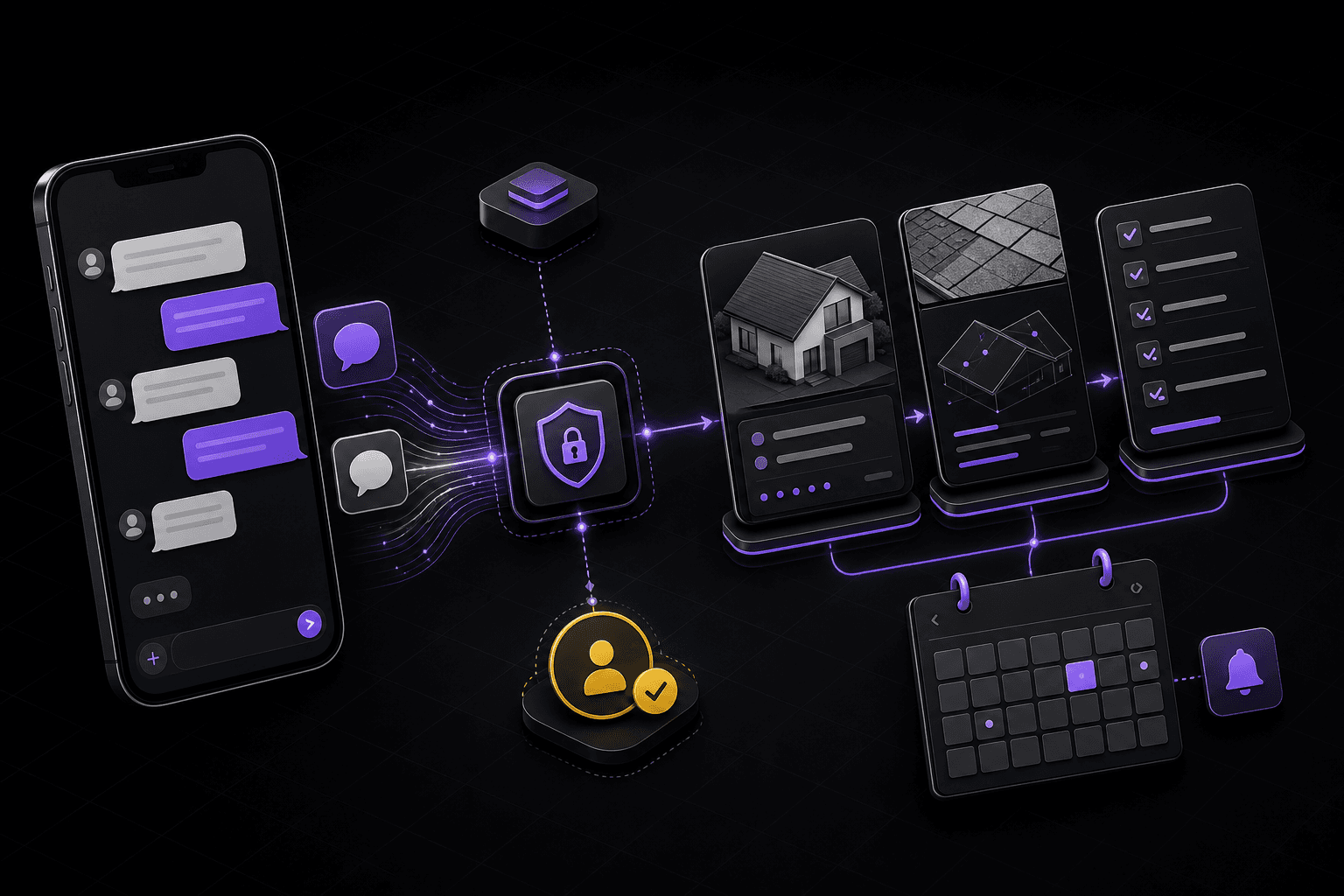
A roofing team can use SMS or WhatsApp as a controlled front door to CRM work: look up a lead, add a note, create a task, schedule a visit, request a roof report, or prepare a follow-up. The messaging channel should not become a second database. Every action needs identity checks, permissions, confirmation for consequential changes, a link to the CRM record, and a clear way to correct mistakes.
This guide is written for U.S. roofing contractors and owner-operators who need a practical process, not a marketing shortcut. The examples are workflow examples rather than engineering, legal, safety, or purchasing instructions. Requirements vary by property, material, jurisdiction, provider, and company policy. Use a qualified person and current source documentation when a decision affects safety, contract terms, or the final customer proposal.
Chat as an interface, CRM as the system
Messages are convenient in the field, while structured records are better for ownership, reporting, history, and automation.
Define the minimum record that must exist before a contact moves stages: property, decision-maker, next action, owner, and source. This prevents text messages or calls from becoming isolated work outside the job record.
For every stage change, capture the owner and the next customer-facing action. A handoff is complete only when the receiving teammate can act without reopening the conversation history.
Contractor check 1: Write every approved change back to the CRM.
Identity and permissions
The system must know which user is messaging and what records or actions that role can access.
Use automation to prepare routine work, then require a person to confirm customer commitments, scope, price, and schedule. The strongest CRM workflow makes accountability clearer rather than hiding it.
Use a short, consistent status such as scheduled, waiting on customer, ready to estimate, or field verification needed. Clear status language makes pipeline reporting usable.
Contractor check 2: Use least privilege and require stronger confirmation for sensitive actions.
Lead and job lookup
A field user can search by name, phone, address, or job reference, but ambiguous matches need clarification.
Review a handful of live records every week for missing next actions, duplicate contacts, and stalled follow-ups. Small corrections made early are easier than cleaning an entire pipeline later.
For every stage change, capture the owner and the next customer-facing action. A handoff is complete only when the receiving teammate can act without reopening the conversation history.
Contractor check 3: Show enough context to prevent updating the wrong property.
Notes and tasks
Natural-language messages can become structured notes or proposed tasks with owner and date. The assistant should display its interpretation before saving.
Define the minimum record that must exist before a contact moves stages: property, decision-maker, next action, owner, and source. This prevents text messages or calls from becoming isolated work outside the job record.
Use a short, consistent status such as scheduled, waiting on customer, ready to estimate, or field verification needed. Clear status language makes pipeline reporting usable.
Contractor check 4: Link the saved item to the source message and user.
Scheduling
A chat workflow can check current availability and prepare an appointment, but calendar conflicts and customer consent remain authoritative.
Use automation to prepare routine work, then require a person to confirm customer commitments, scope, price, and schedule. The strongest CRM workflow makes accountability clearer rather than hiding it.
For every stage change, capture the owner and the next customer-facing action. A handoff is complete only when the receiving teammate can act without reopening the conversation history.
Contractor check 5: Confirm timezone, participant, location, and status before sending.
Roof-report requests
The assistant can collect address, structures, timing, and job context, then prepare a request from the field.
Review a handful of live records every week for missing next actions, duplicate contacts, and stalled follow-ups. Small corrections made early are easier than cleaning an entire pipeline later.
Use a short, consistent status such as scheduled, waiting on customer, ready to estimate, or field verification needed. Clear status language makes pipeline reporting usable.
Contractor check 6: Confirm any purchase or external submission explicitly.
Customer communication
Drafting helps speed, yet opt-in rules, approved templates, tone, and factual accuracy still apply.
Define the minimum record that must exist before a contact moves stages: property, decision-maker, next action, owner, and source. This prevents text messages or calls from becoming isolated work outside the job record.
For every stage change, capture the owner and the next customer-facing action. A handoff is complete only when the receiving teammate can act without reopening the conversation history.
Contractor check 7: Do not send price, scope, or timing claims without current approved data.
Audit, failure, and adoption
Log requests, interpretations, approvals, results, and errors. Provide a human path when the assistant is unsure or an integration fails.
Use automation to prepare routine work, then require a person to confirm customer commitments, scope, price, and schedule. The strongest CRM workflow makes accountability clearer rather than hiding it.
Use a short, consistent status such as scheduled, waiting on customer, ready to estimate, or field verification needed. Clear status language makes pipeline reporting usable.
Contractor check 8: Pilot with reversible actions and review error patterns weekly.
An adoption and data-quality checklist
A checklist makes the guidance operational. It also keeps a team from treating a tool, report, or automation as a substitute for accountable judgment. Use the following items during a pilot and again during periodic review:
Map the current workflow and the desired outcome.
Use least-privilege access and documented ownership.
Test ambiguous, duplicate, and failure scenarios.
Measure correction rate, adoption, and customer impact.
Export and review data before broad rollout.
Document who completed the review, when it occurred, and what changed. If a job or workflow cannot meet the checklist, the safe outcome is to hold the next consequential step, collect the missing evidence, and resume from a known state.
Put the guidance into your workflow
The next useful step is to connect this decision to the system your team already uses. You can explore Sunate Copilot, review the roofing CRM, and book a demonstration. These links provide context; they do not replace a current factual review of capabilities, terms, coverage, or price.
Use the property, scope, and source date recorded in the job file when preparing the next customer conversation.
Sources and methodology
Sunate Copilot — accessed 2026-08-05
Sunate CRM — accessed 2026-08-05
For roofing safety and field-access responsibilities, consult OSHA fall-protection guidance, applicable law, and the contractor’s competent-person procedures.
Evaluate the workflow with your team
Explore Sunate CRM, Sunate Copilot, or book a demonstration.
Field application for your next job
On a live job, apply this guidance with a short pre-job review rather than a broad process meeting. Start by naming the property, the decision due next, and the person accountable for it. Then compare the report, field observations, and customer record for the specific detail that could change scope, timing, or materials. When information conflicts, record the exception, resolve it with the right source, and keep the final decision next to the estimate. This approach helps a small roofing team move quickly without treating a measurement, a CRM note, or an automation as a substitute for contractor judgment. For running a roofing crm through sms and whatsapp, the practical test is simple: can sales, estimating, purchasing, and production understand the same decision without re-entering data or guessing what changed?
In this article
Section headings are available in the article below.
Sources and methodology
Sources and methodology: This article uses reader-facing public sources relevant to U.S. roofing contractors, including Sunate product information at https://www.sunate.app/, Sunate pricing checked August 24, 2026 at https://www.sunate.app/pricing, and OSHA guidance where field access or fall protection is discussed: https://www.osha.gov/fall-protection.
